How Inflation is a Silent Killer?
Originally published 2022-05-12 on the site's earlier chapter as a crypto/Web3 blog. Kept as-is for the record.
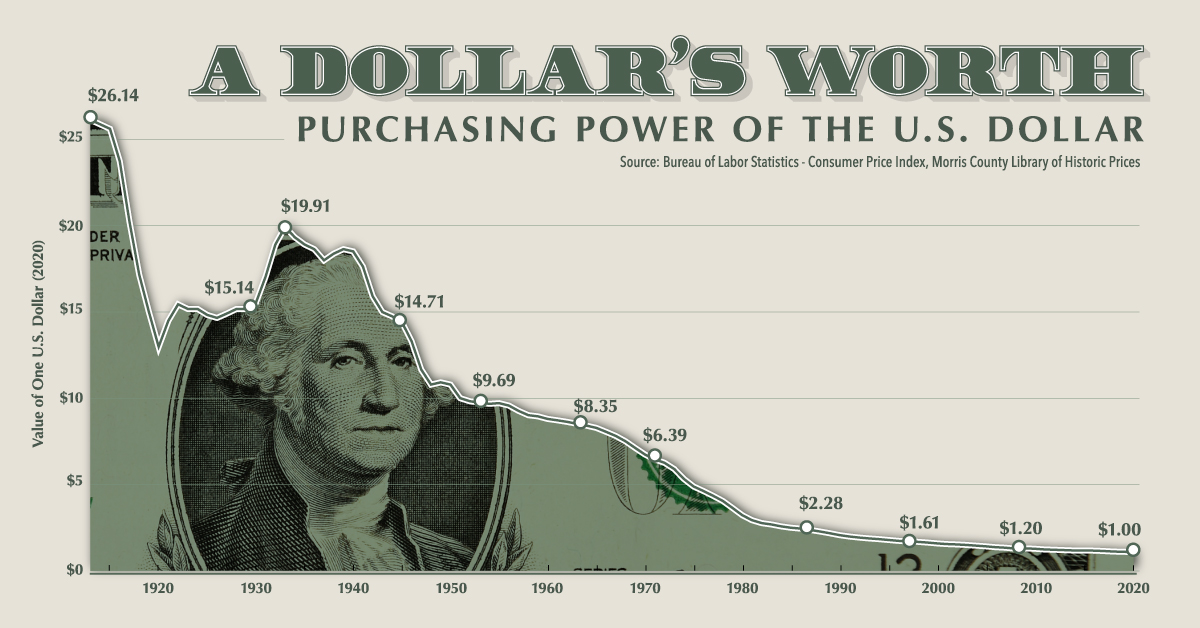
If you belong to an Indian middle class family, I am sure that this topic might have popped up in the dinner conversations. We constantly complain that the price of commodities and daily items is going up on a daily basis. However, little do we know the science behind it. When I try to explain that items aren't becoming expensive but your money's purchasing power is decreasing; I often get raised eyebrows.
So today, I intend to talk about this pressing issue. How inflation is a silent killer? How it is creeping up in your bank accounts, slowly eating away all the money that you have in store. Okay. Enough of demonic portrayal. Let's unfold the science behind inflation.
How Big is the Problem?
The graph above depicts how dollar purchasing power has systematically eroded over 99% in the past 100 years. So, if you are still in a fix about saving, fiat is NOT your friend.
But Why Does Inflation Happen?
You see, the money that you have (Dollar, INR, Euro whatever) is not pegged against anything. What that means is that unlike common belief, nothing is backing up our money. In 1971, Nixon government declared that the dollar is no longer backed by gold.

This gave the feds liberty to print as much of it as they wanted. And thus began the era of fiat. Where central banks of each countries managed supply and demand centrally by printing money at will.
So far, it looks like a good proposition. More money in the system means that you could now fuel the growth of an economy (the primary reason why US did it in the first place). However, more often than not, these banks are quite off in their calculation.

Here's what that means. Imagine you have Rs.100 in circulation. Some external factors (like Covid) force you to increase the money supply in the market (because standstill economy needs a push). Now, there's Rs.120 in supply.
However, the production hasn't changed in this time period. This means more money is now chasing the same amount of goods. It is basic supply and demand from here on. If the demand>supply, the prices go up.
Now you might be able to relate to the initial statement I made. It's not the goods that have increased in price, but your money is devalued to excessive supply.
How does Central Bank Balance this?
With that being said, central banks don't always end up risking the country's economy. They rather run a tight ship of balancing the growth and inflation. How else would our GDPs grow?
And they have a powerful tool to do that job. Yes. Interest rates.
Central banks don't print and flush the money to the end consumers like us directly. They follow a proper channel of doing so through banks. They lend the money to the banks who in turn lend it to you. The rate at which they lend it to the banks is called Repo Rate.
If the central bank decides to increase the repo rate, borrowing becomes expensive and the money is sucked out of the system. This puts a control on the inflation but at the same time, it also hampers growth.

As you might have guessed by now, if they decrease the repo rate, liquidity increases in the market. This is expected to boost growth but also inflate the prices.
Therefore, a healthy threshold of 6-7% inflation is maintained in India. This means each year, money is devalued by this amount OR prices go up (as we might feel).
How does it Impact me?
How much increment did you get in this appraisal cycle? Was it less than 6%? Well, if that's the case you effectively got no raise. Why? Because the purchasing power is anyway going to take a 6% hit due to inflation.

The same principal applies on your investments as well. If you get a fixed deposit done at 6%, after 1 year , tax adjusted, you just lost money in the entire process. You couldn't beat inflation. So while your Rs. 10,000 are 10,600 now. But 10,600 won't be able to purchase what 10,000 could, an year ago!
What Can I Do?
Well, that's why retail investors have to ape into risky schemes like stock markets, debt markets, mutual funds and crypto. Depending on the risk appetite, none of these instruments ensure a guaranteed return. There are of course past trends that validate if you stick around in these markets for long enough, you are bound to make money.
However, given the unprecedented world with viruses and wars that we are in, it is getting unlikelier everyday that past trends will hold true.
Amidst all this, there's a silver lining though. I recently found crypto (yes. Again) bailing me out of this situation. Here are some top avenues that are currently not only beating inflation, but also giving me assured returns with no lock-in period:
A. Vauld:
Vauld is a Singapore based exchange that has been spreading its wings India for a while now. It has been a preferred choice of centralized exchange for many crypto investors out there.
Vauld offers a fixed deposit option for multiple cryptos out there. For eg. if you are willing to lock in your $BTC, $ETH, $MATIC on vauld, you can fetch up to 7% interest. Please bear in mind that interest is paid in the same coin that you have locked in. So if BTC crashes, your earned interest value also crashes along with the principal.

Vauld also offers a similar arrangement for stablecoins. Benefit, you ask? It's the fact that you get a higher yield on a stable coin backed by USD. This would fetch you about 12.68%.
B. MCS:
MCS is another Singapore based exchange that is creating ripples in the Indian market. To bring the next million onboard, MCS is now offering a staggering 16% interest on the stable coins. Let's face it. It is even higher than the best investment options out there. That too passive in nature.

Oh, there must be a very long lock-in period. That's exactly what I thought when I first heard about this. However, turns out there isn't any! You can simply unlock your funds and take away the accrued interest till date with no penalty whatsoever. Isn't that just awesome?
MCS uses this money to fund leverage trades by pro traders on their platform. Obviously they charge a higher fee from them to do so and hence make money in the process.
C. CoinDCX:

CoinDCX is an Indian exchange and a unicorn. It is also offering fixed APYs on some coins. The interest rates are comparatively lesser than MCS but it is a good place to park your funds as you purchase and hold them from the exchange.
Beat that Inflation:
So we learnt that while some form of inflation is inevitable and also healthy in the economy, it often impacts the retail middle class segment of the country, the most. If you manage to keep your eyes and ears open amidst all this, you have fair chance of beating the inflation and appreciating your wealth.
What tactics do you use to take inflation hands-on?
https://www.instagram.com/p/Cc4OkrhPGms/
This blog post is part of the blog challenge ‘Blogaberry Dazzle’ hosted by Cindy D’Silva and Noor Anand Chawla.'